

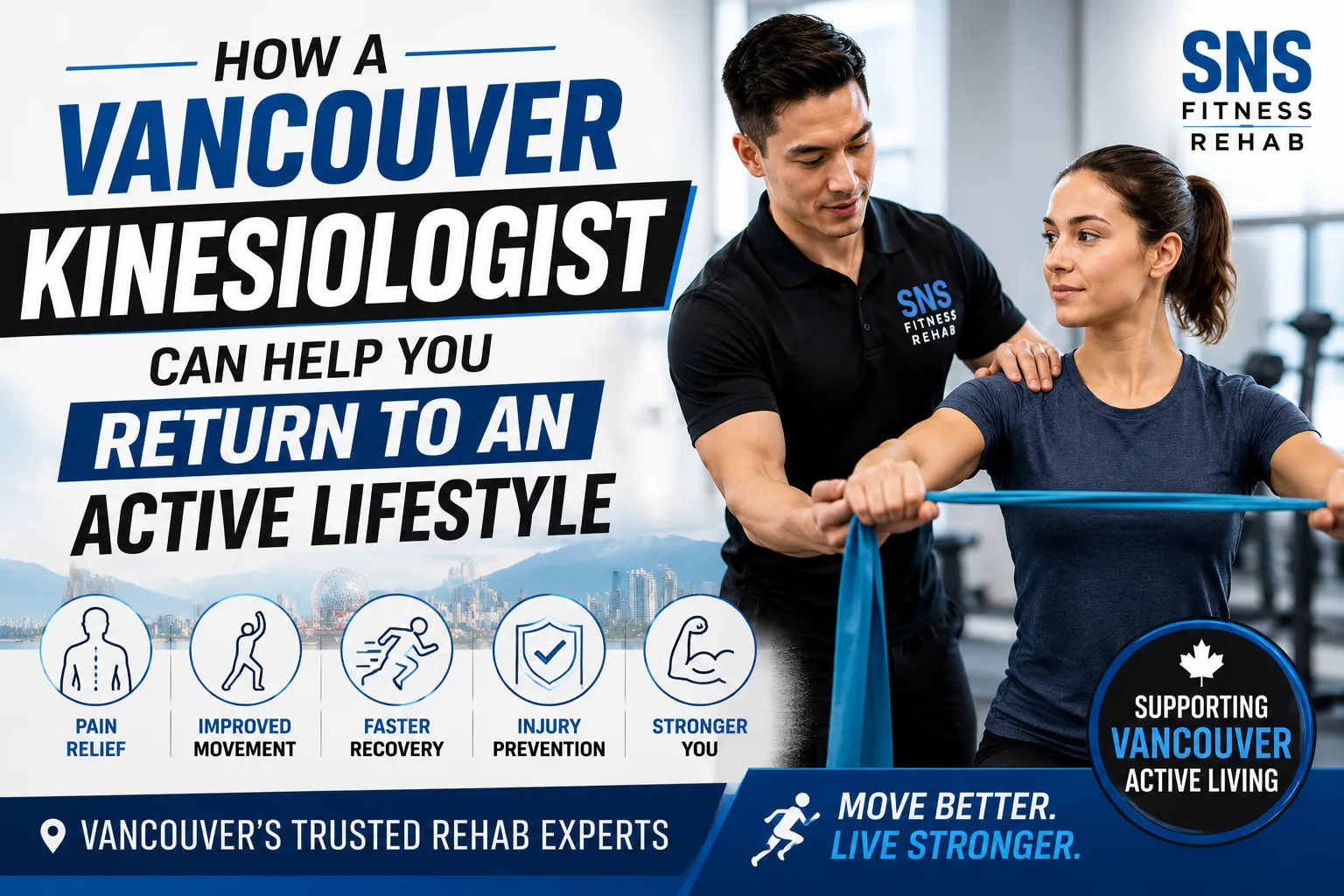
Returning to an active lifestyle after an injury, prolonged inactivity, or physical limitation can feel challenging. You may have regained basic movement but still lack the strength, confidence, or endurance needed for everyday activities and exercise.
Working with a Vancouver kinesiologist can provide a structured approach to rebuilding physical capacity. Through individualized exercise and movement programs, kinesiology can help bridge the gap between rehabilitation and a more active lifestyle.
What Does a Vancouver Kinesiologist Do?
A kinesiologist specializes in human movement and applies principles of exercise science, biomechanics, and physical activity to individualized programs.
Depending on their qualifications and scope of practice, they may help clients work on:
-
Strength and conditioning
-
Mobility and flexibility
-
Balance and coordination
-
Functional movement
-
Exercise rehabilitation
-
Workplace recovery
-
General fitness
-
Athletic performance
The program is typically adapted to the individual’s abilities, limitations, and goals.
Who Can Benefit From Kinesiology?
You don’t necessarily need to be an athlete or have a serious injury to benefit from kinesiology.
A kinesiologist may work with people who are:
-
Returning to exercise after an injury
-
Recovering from a period of inactivity
-
Managing movement limitations
-
Preparing to return to work
-
Building general strength and fitness
-
Improving balance and mobility
-
Returning to recreational sports
-
Looking for structured exercise guidance
The first step is understanding your current physical abilities and what you want to accomplish.
How Kinesiology Can Support Your Return to Activity
1. Rebuild Strength Gradually
Inactivity can contribute to reduced muscular strength. A progressive resistance program can help rebuild capacity without immediately placing excessive demands on the body.
Exercises can be adjusted by changing resistance, repetitions, range of motion, or movement complexity.
2. Improve Mobility
Stiffness can make everyday movements more difficult. Mobility exercises can be incorporated alongside strengthening work to support comfortable and efficient movement.
3. Develop Balance and Stability
Balance and stability are important for everyday activities as well as recreational exercise. A personalized program may include exercises that challenge coordination and control.
4. Restore Functional Movement
Returning to an active lifestyle isn’t simply about becoming stronger in the gym. You also need to be able to use that strength during real-world activities.
Functional exercises can replicate movements such as:
-
Squatting
-
Stepping
-
Lifting
-
Reaching
-
Carrying
-
Rotating
From Rehabilitation to Fitness
One of the challenges after an injury is knowing how to transition from rehabilitation exercises to regular fitness.
A progressive approach may move through stages such as:
-
Basic movement
-
Strength development
-
Balance and stability
-
Functional conditioning
-
Activity-specific training
-
Return to recreational or athletic activity
The exact progression depends on the individual and the nature of their previous injury or limitation.
Creating a Personalized Exercise Plan
A good exercise program should reflect your current abilities rather than simply following a generic routine.
An assessment may consider:
-
Previous injuries
-
Current activity level
-
Strength
-
Mobility
-
Balance
-
Movement patterns
-
Fitness goals
-
Work or recreational demands
The program can then be adjusted as your abilities change.
Why Consistency Matters
Returning to an active lifestyle is a process rather than a single workout or appointment.
You can support your progress by:
-
Following your exercise program consistently
-
Increasing activity gradually
-
Prioritizing proper technique
-
Allowing adequate recovery
-
Getting sufficient sleep
-
Maintaining appropriate nutrition and hydration
-
Communicating changes in symptoms with your healthcare team
Progress doesn’t always happen at the same rate every week. Programs may need to be modified as your body adapts.
When Should You Seek Professional Guidance?
If you’re recovering from an active injury, surgery, significant pain, or another medical condition, appropriate healthcare guidance should come before increasing exercise intensity.
A kinesiologist can work within their professional scope and, when appropriate, coordinate with other healthcare professionals involved in your care.
Frequently Asked Questions
Can a Vancouver kinesiologist help me return to exercise after an injury?
Yes, a kinesiologist may help with progressive exercise after appropriate assessment and clearance, focusing on areas such as strength, mobility, balance, and functional capacity.
Do I need to be injured to see a kinesiologist?
No. Kinesiology can also support general fitness, mobility, strength development, conditioning, and athletic performance.
How long does it take to return to an active lifestyle?
There is no universal timeline. Recovery depends on factors such as the type of injury, current fitness level, treatment, consistency, and individual response to exercise.
Can kinesiology help athletes return to sport?
Once appropriately cleared, progressive strength, conditioning, and sport-specific training can help athletes transition toward their normal activities.
Conclusion
A Vancouver kinesiologist can provide valuable support for individuals who want to move from rehabilitation, inactivity, or physical limitations toward a more active lifestyle. Personalized exercise programming can address strength, mobility, balance, stability, and functional movement while allowing progress to occur gradually.
The goal isn’t simply to complete a workout. It’s to develop the physical capacity and confidence needed to participate in the activities that matter to you—whether that’s walking comfortably, returning to work, exercising regularly, or getting back to your favorite sport.
For more movement, rehabilitation, and fitness resources, visit SNS Fitness & Rehab.